
Two Ancient Relics Discovered in the Philippines Reveal a Forgotten Hindu-Buddhist Past
Sep 29, 2026 • Mike Uy

Sep 29, 2026 • Mike Uy
The scenes leap straight out of a classic Indiana Jones movie opener. Picture this: A mysterious engraved metal plate slowly surfaces along a quiet river in Laguna, while in Mindanao, a storm and a flood push a solid gold statuette out of a muddy riverbank. This time, however, it is not Harrison Ford with his trademark bullwhip and outback fedora who rushes in to claim the relics, but ordinary people who stumble into a barely explored chapter of the country’s pre-colonial past.
Before the arrival of Islam, and way before Spanish conquistadors brought Catholicism to our shores, Hinduism and Buddhism were vibrant in pre-colonial Philippine society. Two relics survived to prove this connection. One is the Laguna Copperplate Inscription with script engraved in Sanskrit, and the other is the Golden Tara of Agusan, a statuette cast in solid gold.

Believed to have been carried over the sea from India, the Laguna Copperplate Inscription is basically a 1,100-year-old “your debt is forgiven” message or a debt acquittal document. Unlike your Indiana Jones movie, however, the discovery of this relic was quiet and unassuming: no booby traps, and no angry villagers to chase away a nosy archaeologist.
Laborer Ernesto Legisma discovered the copper plate in 1989 while dredging sand with a mechanical conveyor near the mouth of the Lumbang River in Lumban, Laguna. What Legisma recovered was a blackened, crumpled roll of metal. When unfurled, Legisma noted fine characters hammered into its surface. Nobody at that moment could have known that what the laborer discovered would turn out to be the single oldest piece of writing ever recovered on Philippine soil.
After its discovery, the copperplate, 0.1 centimeters thick and measuring 20 centimeters high and 30 centimeters wide, first entered the antiquities market. The plate was first offered in August 1989 to Albert Dealino, an antique dealer in Siniloan. Dealino later sold it to William Elwell, a coin dealer in Manila, who then passed it to Venancio Magbuhos. In 1990, Magbuhos offered the artifact to the National Museum of the Philippines. The museum acquired the plate for roughly P2,000 and registered it under accession number 1990-B-1.

A careful examination of the plate showed it was covered on one side by a ten-line inscription. The text of the inscription ended abruptly at the tenth line, in the middle of a sentence. Unable to decipher the inscription, the museum gave the text to Dutch anthropologist Antoon Postma, who was then based in the Philippines, to analyze.
Postma identified the date of the copperplate’s creation as the “Year of Sakya 822, month of Viasakha” which in 1995 was converted by the late paleographer Hector Santos as Monday, April 21, 900 AD in the Gregorian calendar. The text on the plate is in Kawi script, an indigenous writing system in Java and Sumatra that predated baybayin, and can be traced all the way back to the Pallava script of India.
The text itself is a linguistic time capsule: mostly Old Malay, spiked with Sanskrit legal vocabulary, laced with honorifics scholars still argue over as Old Javanese and Old Tagalog.
And after all that buildup, the actual message carried by the plate is almost comically mundane: a noble named Namwaran and his family were formally cleared from a debt of 926.4 grams of gold by the chief of Dewata (now part of Butuan City), as testified by the ruler of Tundun (now Tondo, Manila) and ruled by the court of Mdang (now in Java, Indonesia).
In 1995, the late paleographer Hector Santos converted the date declared in the copperplate document, written in Saka (the Indian calendar), to the Gregorian calendar as Monday, 21 April 900 AD.
This proves that even before Spain “discovered” the Philippines, bureaucrats in pre-colonial Luzon were already issuing legal paperwork, such as debt relief certificates, written in a script from India, in a language borrowed from the Malay world, and based on a calendar imported from South Asia.
But what is truly astonishing about the Laguna Copperplate Inscription is that it pushed back the start of recorded Filipino history by some 600 years, as historians had almost universally accepted that the history of the Philippines only dated back to 1521 when records noted the arrival of the Portuguese explorer Ferdinand Magellan and the chronicler Antonio Pigafetta.
The inscription on the plate details the population and culture of the pre-colonial Philippines. In addition, the plate also showed that at the time of the inscription’s writing, pre-colonial Philippines was already a bustling society with a strong international trading network across Southeast Asia.
The Laguna Copperplate Inscription has been decoded and interpreted many times. Postma’s original interpretation managed to identify names of places that were located along the Angat River-Pampanga River-Manila Bay complex. These includes Pailah, which is Sitio Paila, San Mateo, Norzagaray, Bulacan province (part of the headwater of Angat River); Puliran is the now Pulilan, Bulacan, also along Angat River; Binoangan is Binuangan, Obando, Bulacan; and the ruler named Bukah in the copperplate was likely the derivation of the place name Gatbuca, a barangay in Calumpit, Bulacan where the Angat River and Pampanga River meet (gat was an ancient Tagalog-Kapampangan honorific title for noblemen).
Laguna historian Jaime Tiongson, meanwhile, offered another interpretation: the context of the complex of Laguna de Bai (Lake of Bai). Although the document was found in the Lumbang River, which connects Laguna de Bai to the sea, Pailah was the archaic name of the lake town of Pila, now part of Laguna; Puliran was the pre-Hispanic name of Laguna de Bai.
One simple relic proved that Luzon, Mindanao, Java, and India were connected and interacted more than 600 years before the Magellan-Elcano expedition arrived in the Visayas.
The Laguna Copperplate Inscription is now a permanent exhibit at the National Museum of Anthropology in Manila. It is certified as among the country’s National Cultural Treasures.
But Luzon is only half of the relic discovery trail. Follow the trail south to Mindanao, and the story stops about paperwork and starts talking more about gold.
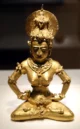
The year is 1917, and a storm exposes a 21-karat gold statuette in the muddy banks of the Wawa River near Esperanza, Agusan del Sur. Roughly about 12 cm tall and weighing nearly 2 kilograms, the statuette of what appears to be a seated female deity dressed head to toe in an elaborate headdress and jewelry, would later be known as the Golden Tara of Agusan.
Believed to be from the 9th to 10th century or about the same time window as the Laguna Copperplate Inscription, the golden statuette recovered in Agusan is believed to be a “tara” or a Buddhist bodhisattva of compassion, though some have argued that the statuette is of a Hindu goddess.
The Agusan golden statuette depicts a seated female figure in the padmasana or full lotus position, with the legs folded and crossed, and each foot resting on the opposite thigh. The image is oriented frontally and is depicted as wearing a floriated mountain-shaped crown and a halo, neck adornments, a long chain crossing her breasts and back, a low waistband with a quatrefoil near the navel. The arms are akimbo, with the fingers curled inward.
According to American anthropologist Henry Otley Beyer, an unidentified Manobo woman accidentally found the golden statuette protruding from the mud on the left bank of the Wawa River, a tributary of the Agusan River, after a storm and flood.

The image later resurfaced in the hands of a local official named Blas Baklagon, who brought it to Beyer in 1918. Beyer tried to convince the American colonial government to buy the statuette for the National Museum of the Philippines. But without funds to buy the statuette for the national museum, the Agusan Coconut Company took it to settle a debt Baklagon owed them.
Later, word of the golden statuette reached Louise Wood, wife of then American Governor-General Leonard Wood, who feared the image might be melted down for its gold value and raced to save it. She teamed up with Fay Cooper Cole, a curator from Chicago’s Field Museum, and Shaler Matthews, a professor in the Divinity School at the University of Chicago, to raise the money for the purchase. In 1922, the Field Museum in Chicago successfully acquired the image. The Golden Tara of Agusan remains on display at the Grainger Hall of Gems at the Field Museum of Natural History in Chicago.
The Golden Tara’s presence in the country’s pre-colonial history suggests a possible Hindu-Buddhist period, most likely linked to the Sri Vijaya and Majapahit cultures of Indonesia, before the arrival of Islam and Christianity.
But the story of the Golden Tara is far from being over. Filipino scholars and officials later mounted a campaign to bring the image back to the Philippines. One of the loudest voices in this fight was the late Senator Aquilino “Nene” Pimentel Jr., who used his final privilege speech in the Senate to call for the image’s return to Mindanao. A 2018 GMA Network documentary also reignited public interest in the golden image, with communities in Agusan del Sur urging researchers to build the case for its return.
So what do these two relics mean? Both artifacts date to roughly 900–1000 CE, and both physically prove the same buried truth: pre-colonial Philippine communities — Tondo in the north, and Agusan del Sur in the south — were directly involved in the Hindu-Buddhist trade and cultural sphere that stretched across Java, Sumatra, the Srivijaya and Majapahit networks, and then back to South Asia.
The existence of the Laguna Copperplate Inscription and the Golden Tara of Agusan centuries before the arrival of Europeans proves that pre-colonial Philippines already had literacy, law, international trade, and organized religion.
Pre-colonial Philippine history is a subject usually glossed over in classrooms and in textbooks. The Laguna Copperplate Inscription and the Golden Tara of Agusan are surviving evidence that Hindu-Buddhist civilization left fingerprints across the Philippines long before “Filipino” identity even existed. These fingerprints remain visible today in the words we speak, the names on our maps, and in the rich pre-colonial cultural memory that colonization tried very hard to bury for good.
Check us out on Facebook, Instagram, X, TikTok, and YouTube, to be the first to know about the latest news and coolest trends!

Input your search keywords and press Enter.


